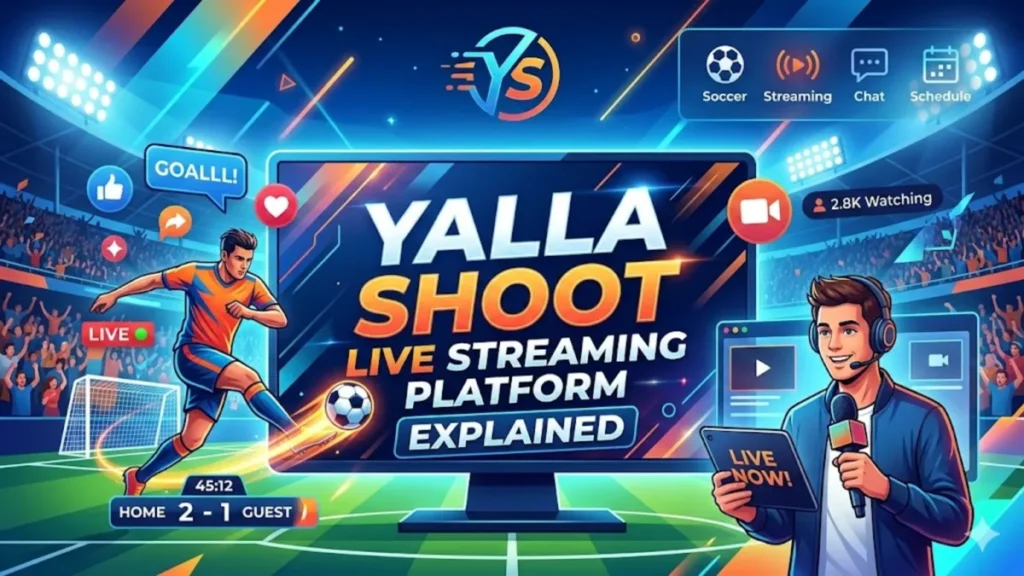

I first heard the phrase “Yalla Shoot” shouted across a café in Cairo, just minutes before kickoff in a European Champions League match. Within seconds, phones were out, links were shared, and a stream flickered to life. Yalla Shoot, known in Arabic as “يلا شوت,” has become one of the most searched sports-streaming names across the Middle East and North Africa. It is primarily a football-focused digital platform that aggregates live match streams, real-time scores, standings, and schedules for major leagues including the English Premier League, La Liga, Serie A, Bundesliga, and UEFA competitions.
For millions of users, Yalla Shoot functions as a one-stop ecosystem. It offers match listings, lineups, goal alerts, and embedded video players through a constellation of mirror domains. The appeal is simple: free access, fast updates, and minimal barriers to entry. Yet beneath its popularity lies a more complex reality. Yalla Shoot operates in a gray zone of sports broadcasting rights, advertising economics, and digital enforcement. Rights-holders invest billions in licensing agreements. Platforms like Yalla Shoot bypass those structures.
The result is a digital tug-of-war that speaks to larger global questions. Who controls access to live sports? What happens when demand outpaces affordability? And how do governments and broadcasters respond to decentralized streaming ecosystems that replicate faster than they can be shut down?
What Yalla Shoot Is and How It Works
Yalla Shoot is best understood as an aggregation platform rather than a traditional broadcaster. It lists live football matches by date and competition, displays kickoff times adjusted to regional time zones, and provides multiple streaming links for each fixture. Users typically select a match, choose video quality, and watch via embedded players often hosted on third-party servers.
The site’s ecosystem includes variations such as Yalla Shoot Live, Yalla Shoot HD, and Yalla Scores. Some focus primarily on live scores and statistics rather than video. Others emphasize streaming quality. Many versions operate through mirror domains, enabling continuity if one address is blocked.
Core features typically include:
- Live match streams
- Real-time score updates
- Team lineups and substitutions
- League standings and top scorer charts
- Post-match highlights
Unlike official broadcasters, Yalla Shoot does not require subscription credentials. Revenue flows primarily through advertising networks, including pop-ups and redirect ads.
The structure mirrors other unofficial streaming hubs worldwide. Accessibility fuels growth. So does the global appetite for football, the world’s most watched sport.
Read: Fxggxt Meaning Explained: How Fxggxt Reveals Digital Language Patterns
The Economics of Broadcast Rights
To understand Yalla Shoot’s appeal, I look first at the economics of sports broadcasting. According to Deloitte’s Annual Review of Football Finance, European football broadcasting revenues reached billions annually, driven largely by television rights agreements (Deloitte, 2023). The English Premier League alone secured domestic rights worth £5.1 billion for the 2022 to 2025 cycle (Premier League, 2022).
Broadcasters such as beIN Sports, Sky Sports, and DAZN pay enormous sums for exclusive rights. Those costs are passed to consumers through subscription fees. In regions where average incomes are lower, subscription packages may feel prohibitively expensive.
The contrast becomes clear:
| League | Rights Value (Recent Cycle) | Example Broadcasters |
|---|---|---|
| EPL (2022–2025) | £5.1 billion domestic | Sky Sports, BT Sport |
| UEFA Champions League (2021–2024) | €3.6 billion | beIN Sports, CBS |
| La Liga (2022–2027) | €4.95 billion | Movistar, DAZN |
High rights costs incentivize piracy and unauthorized streaming. Economist Stefan Szymanski has argued that football’s global commercial expansion inevitably creates access gaps (Szymanski, 2015). Platforms like Yalla Shoot fill those gaps.
Legality and Enforcement
Yalla Shoot does not hold official broadcast licenses for major competitions. In many jurisdictions, distributing copyrighted live sports without authorization constitutes infringement. Enforcement efforts have intensified over the past decade.
In 2017, the European Union strengthened measures against illegal streaming under its Digital Single Market strategy (European Commission, 2017). Broadcasters increasingly collaborate with anti-piracy firms to identify and block infringing domains in real time.
However, enforcement remains complex. Domains shift. Mirror sites emerge. Content hosting may occur in multiple countries simultaneously. The legal landscape varies by region. While operators face significant liability, individual viewers are rarely prosecuted, though the legal risk remains ambiguous.
Media scholar Ramon Lobato has written that digital piracy often reflects “access asymmetry rather than criminal intent” (Lobato, 2019). The observation does not excuse infringement but frames it within global inequality of access.
The tension between enforcement and demand continues to define Yalla Shoot’s operational environment.
Advertising, Malware, and User Risk
Yalla Shoot-style sites rely heavily on advertising. Pop-up ads, redirect pages, and third-party video hosts generate revenue. That advertising density introduces security concerns.
Cybersecurity experts consistently warn that unofficial streaming sites are frequent vectors for malware and phishing attacks. The Federal Bureau of Investigation in the United States has cautioned that illicit streaming services may expose users to malicious software (FBI, 2022).
Users navigating such sites face several risks:
| Risk Type | Description | Mitigation |
|---|---|---|
| Malware | Hidden downloads via ads | Updated antivirus software |
| Phishing | Fake login/payment prompts | Avoid entering personal data |
| Tracking | Third-party data collection | VPN and privacy-focused browsers |
| Device compromise | Unauthorized extensions | Avoid custom “players” |
Bruce Schneier has emphasized that security depends on layered defenses rather than blind trust in digital platforms (Schneier, 2015). In practical terms, users who access such sites often rely on ad blockers and VPNs, though these tools do not legalize infringing streams.
The risks underscore the broader trade-off between cost and security.
Cultural Impact Across the Arab World
Yalla Shoot’s popularity cannot be separated from football’s cultural resonance. In countries such as Egypt, Morocco, Saudi Arabia, and Algeria, European club football commands massive audiences. Cafés project matches onto walls. Families gather around televisions.
Digital platforms extend that communal experience to mobile screens. When official rights are fragmented across multiple paid services, unofficial hubs become convenient alternatives.
Sociologist Manuel Castells has argued that networked societies reshape how communities experience media events (Castells, 2010). Yalla Shoot exemplifies that shift. It compresses global competitions into accessible digital lists, available at a tap.
The platform’s Arabic interface also matters. Localization creates familiarity. It signals belonging within a regional digital sphere.
In that sense, Yalla Shoot is more than a streaming aggregator. It is part of a shared football culture that transcends borders while operating within linguistic identity.
The Rise of Mirror Domains
One defining characteristic of Yalla Shoot is its network of mirror sites. When authorities block one domain, another appears. The resilience mirrors patterns observed in other digital piracy ecosystems.
According to a 2022 report by MUSO, a piracy analytics firm, streaming remains the dominant method of accessing infringing content worldwide (MUSO, 2022). Site operators adapt quickly to takedowns.
This cat-and-mouse dynamic reflects technological asymmetry. Blocking at the domain level rarely eliminates content distribution entirely. Instead, it disperses traffic across new addresses.
Digital policy experts note that enforcement must balance copyright protection with broader internet freedoms. Overblocking can inadvertently restrict legitimate content.
Yalla Shoot’s persistence demonstrates how decentralized infrastructure complicates centralized control.
Legal Alternatives and Official Platforms
Despite the proliferation of unofficial streaming hubs, legal alternatives continue to expand. Platforms such as DAZN, ESPN+, and beIN Sports Connect offer subscription-based streaming tailored to specific regions.
Live-score apps such as SofaScore, Flashscore, and OneFootball provide real-time updates without video. These services operate legally and monetize through ads or subscriptions.
The contrast between unofficial and official platforms becomes clear:
| Feature | Yalla Shoot | Official Broadcaster |
|---|---|---|
| Cost | Free | Subscription required |
| Licensing | Unlicensed streams | Official rights holder |
| Video Quality | Variable | High-definition, stable |
| Ads | Heavy pop-ups | Managed ad formats |
| Legal Risk | Potential infringement | Legal viewing |
For many fans, the decision comes down to affordability and reliability. Official services offer stability and legitimacy. Unofficial sites offer immediacy and zero subscription cost.
The global debate over sports access continues to shape these choices.
App Ecosystem and Mobile Access
Yalla Shoot-branded applications on Google Play and Apple’s App Store often focus primarily on live scores rather than full streaming. App store guidelines impose stricter moderation standards.
Mobile access amplifies reach. Smartphones remain the primary internet access point across much of the Middle East and North Africa. The GSMA reported in 2023 that mobile internet penetration in the MENA region exceeded 70 percent (GSMA, 2023).
Push notifications, live score alerts, and lineup updates create a dynamic engagement loop. Even users who avoid video streams may rely on the platform for scheduling information.
The blending of official app-store presence with mirror streaming sites reflects the blurred boundary between score aggregation and unauthorized distribution.
In digital ecosystems, branding coherence often masks operational fragmentation.
The Broader Debate Over Access
At its core, Yalla Shoot embodies a fundamental tension in global media: premium content versus universal access. Football’s worldwide popularity collides with regionally fragmented licensing models.
Legal scholar Lawrence Lessig once argued that code functions as law in cyberspace (Lessig, 1999). Digital architecture shapes behavior. When barriers are high, workarounds emerge.
The question becomes not only whether Yalla Shoot is legal, but why such platforms flourish. Economic inequality, regional broadcasting monopolies, and digital literacy all intersect.
For some fans, unauthorized streaming is a necessity. For others, it is convenience. For rights-holders, it represents revenue loss.
The debate remains unsettled, shaped by evolving technology and consumer expectation.
Takeaways
- Yalla Shoot is an Arabic-focused football streaming and live-score platform widely used in the MENA region.
- It aggregates unlicensed live streams alongside match schedules, lineups, and standings.
- Broadcast rights for major leagues cost billions, driving subscription fees and access disparities.
- Enforcement efforts struggle against rapidly shifting mirror domains.
- Users face potential legal ambiguity and cybersecurity risks.
- Official alternatives offer legal stability but require payment.
- The platform reflects broader tensions between affordability, access, and intellectual property.
Conclusion
When I revisit that café in Cairo, I remember the excitement more than the legal intricacies. A crowd leaned toward a small screen, united by anticipation. Yalla Shoot existed in that moment as a bridge between global spectacle and local gathering.
Yet the bridge is precarious. It stands at the intersection of technology, commerce, and law. Football’s commercial expansion has elevated the sport’s economic value while raising barriers to entry. Unofficial streaming platforms respond to that imbalance with speed and adaptability.
The future likely belongs to hybrid solutions: more flexible subscription tiers, expanded free highlights, regional pricing models, and improved enforcement technology. Whether Yalla Shoot persists or evolves under a different name, the demand it reflects will remain.
Access to sport is not merely entertainment. It is cultural participation. And wherever participation feels restricted, alternative pathways will emerge.
FAQs
Is Yalla Shoot legal?
In most countries, it does not hold official broadcast licenses, making its live streams legally questionable or infringing depending on jurisdiction.
Is Yalla Shoot free?
Yes. Most mirror sites and apps offer free access supported by advertising networks.
Can using Yalla Shoot expose me to malware?
Unofficial streaming sites often carry intrusive ads and potential security risks, including phishing and malicious downloads.
What are safer alternatives?
Official broadcaster apps like beIN Sports Connect, DAZN, or ESPN+, and legal live-score apps like SofaScore and Flashscore.
Why is Yalla Shoot so popular?
It provides easy, free access to major football matches in Arabic-friendly interfaces, addressing affordability and accessibility gaps.