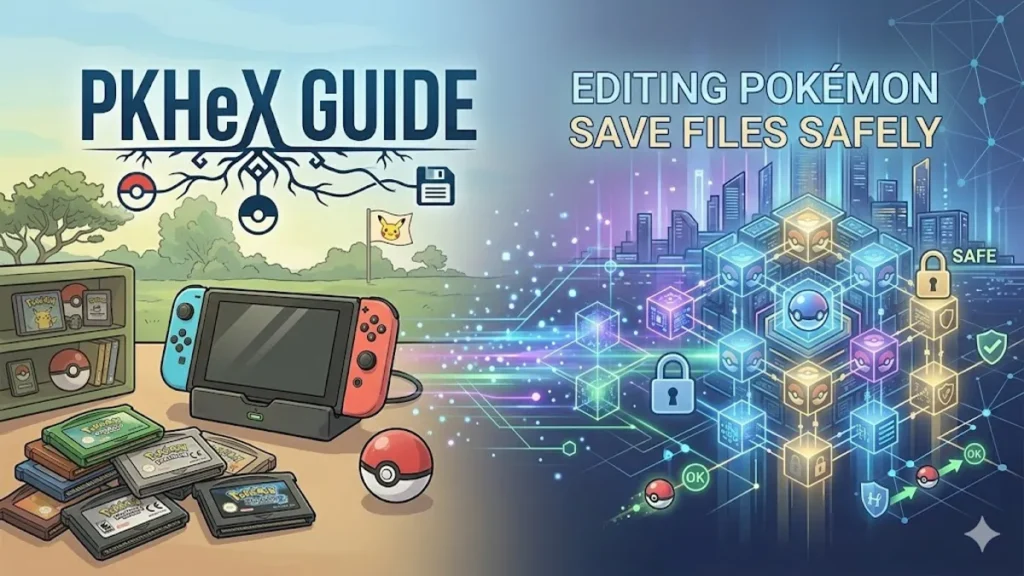

PKHeX is a free, open source Pokémon save file editor that allows players to directly modify Pokémon, items and trainer data in most core series games, from Game Boy Advance titles to Nintendo Switch releases. It reads and writes common save formats such as .sav, .bin and .dat files, enabling users to adjust everything from a Pokémon’s level and moveset to its individual values and origin data. For many players, it is a powerful customization tool. For others, it is a controversial shortcut in competitive environments.
I first encountered PKHeX not in a hacker’s forum but in a competitive discussion thread about perfect IV spreads in Pokémon Scarlet and Pokémon Violet. The tone was pragmatic rather than rebellious. Players debated efficiency, legality checks and the ethics of digital tinkering. Since its earliest public releases more than a decade ago, PKHeX has evolved alongside Nintendo’s hardware generations, mirroring the franchise’s own technological shifts.
At its core, PKHeX does not alter game code. It edits the save file that stores player progress. That distinction has made it both accessible and divisive. In a world where Pokémon has sold more than 480 million units worldwide, according to The Pokémon Company, the desire to shape one’s roster with surgical precision reflects a deeper truth: modern games are as much about data as they are about adventure.
What PKHeX Actually Does
PKHeX functions as a portable Windows application, meaning no formal installation is required. Users download the executable file from its official GitHub repository, created and maintained by developer Kurt “Kaphotics” Osch. Once opened, the program allows players to load decrypted Pokémon save files and view their contents in a structured interface.
The software supports a wide range of core series games, from Pokémon Ruby and Sapphire on the Game Boy Advance to Pokémon Sword, Shield, Scarlet and Violet on the Nintendo Switch. It reads formats such as .sav for older titles and .bin or main files for newer Switch saves. The program parses encrypted data and presents it in editable fields, including Pokémon species, level, moves, abilities, IVs, EVs, shininess and held items.
Crucially, PKHeX includes a built in legality checker. This feature evaluates whether an edited Pokémon could plausibly exist within official game parameters. It flags impossible combinations, such as moves learned before release dates or location data inconsistent with the selected game. While not a guarantee of online safety, it offers users a guide to stay within mechanical limits.
Cybersecurity researcher Nadia Heninger once observed that “data is the true substrate of digital systems” (Heninger, 2018). PKHeX demonstrates that principle in miniature. By manipulating data rather than code, it reshapes the player experience at its most fundamental level.
Read: Madalad: From Estonian Word to Blockchain Security
Supported Generations and File Types
PKHeX’s appeal lies partly in its breadth. Unlike single generation editors of the early 2000s, it spans multiple hardware eras. The following table summarizes its compatibility:
| Generation | Example Titles | Platform | Common Save Format |
|---|---|---|---|
| Gen III | Ruby, Sapphire | GBA | .sav |
| Gen IV | Diamond, Pearl | DS | .sav |
| Gen VI | X, Y | 3DS | main |
| Gen VIII | Sword, Shield | Switch | main/.bin |
| Gen IX | Scarlet, Violet | Switch | main |
On consoles, accessing save files typically requires a modified system and a save manager such as Checkpoint or JKSM. These homebrew applications extract decrypted saves that PKHeX can read. On PC, players often pair PKHeX with emulators, allowing direct editing without console hardware.
The open source nature of PKHeX means its codebase is publicly available on GitHub, where contributors submit updates aligned with new game releases. Open source licensing under the GNU General Public License reinforces transparency, though Nintendo does not endorse or support the tool.
How Players Begin Using PKHeX
The process begins with downloading the latest release from the official GitHub repository at github.com/kwsch/PKHeX/releases. Users typically create a dedicated folder, place PKHeX.exe and its required library file in it, and launch the program. Because it is portable software, no installation wizard is involved.
After extracting a save file from a console or emulator, users drag and drop the file into the PKHeX window. The interface displays storage boxes on the left and editable tabs on the right. Tabs labeled Main, Met, Stats, Attacks and SAV correspond to specific data categories.
The table below outlines core editing areas:
| Tab | Function | Typical Use |
|---|---|---|
| Main | Species, level, shiny status | Create or modify Pokémon |
| Met | Origin location, date, Poké Ball | Ensure legality alignment |
| Stats | IVs, EVs, nature, ability | Optimize competitive stats |
| Attacks | Moveset and PP | Customize battle strategy |
| SAV | Items, Pokédex, trainer info | Edit inventory and ID |
After making changes, users can run the legality checker. If flagged, they adjust metadata such as encounter location or transfer history. Once satisfied, they export the edited save and re inject it into their system.
Legality, Risk and Competitive Boundaries
The legality checker is central to PKHeX’s identity. It analyzes encounter data, PID generation methods and event distributions. Still, legality within PKHeX does not equal official approval.
Nintendo and The Pokémon Company have enforced strict rules in official competitions. According to Play Pokémon Championship Series regulations, players may be disqualified for using “modified or altered game data” (The Pokémon Company International, 2023). In past years, disqualifications have occurred at regional events when hacked Pokémon were detected.
In 2023, Pokémon Home, the franchise’s cloud storage service, implemented additional checks to block Pokémon with invalid data from transfer (The Pokémon Company, 2023). These measures underscored an ongoing cat and mouse dynamic between modification tools and official systems.
Esports scholar T. L. Taylor has written that competitive gaming depends on “shared trust in the integrity of digital systems” (Taylor, 2012). PKHeX occupies a gray space within that trust framework. Casual online ladder matches may not trigger detection, but official tournaments carry higher scrutiny.
For some players, PKHeX is a training ground. They test team compositions in Pokémon Showdown, an online battle simulator, before recreating legal equivalents in game. For others, the tool is purely for offline experimentation, personalizing single player campaigns without competitive intent.
The Ethics of Digital Editing
The ethics surrounding PKHeX mirror broader debates about modification in gaming. Modding communities have long altered single player titles, from The Elder Scrolls to Stardew Valley. Pokémon differs because of its competitive ecosystem and transferable creatures.
Game studies professor Mia Consalvo argues that cheating and modding are culturally contextual practices, often shaped by community norms rather than universal rules (Consalvo, 2007). Within Pokémon circles, attitudes toward PKHeX vary. Some see it as efficiency in a grind heavy system. Others view it as undermining effort and rarity.
The franchise’s design has evolved to reduce the need for external editing. Features like Hyper Training and Nature Mints, introduced in Pokémon Sun and Moon and expanded in later titles, allow in game stat optimization. These mechanics suggest Game Freak recognized player demand for customization.
Still, the lure of absolute control remains. PKHeX provides instant access to perfect IV spreads, event exclusive forms and rare shinies. The temptation lies not just in power but in precision.
Open Source Development and Community
PKHeX’s open source foundation has allowed rapid adaptation. When Pokémon Scarlet and Violet launched in November 2022, compatibility updates followed as researchers analyzed the new save structure. Contributors track changes in encryption and metadata to maintain functionality.
The project is hosted on GitHub under the account kwsch. Open issue trackers document bug reports and feature requests. This transparency contrasts with older closed source editors that circulated in obscure forums.
Open source advocate Eric Raymond famously described the “bazaar” model of software development, where many contributors improve code collaboratively (Raymond, 1999). PKHeX exemplifies that ethos within a niche gaming community.
Plugins extend its capabilities. Separate repositories offer tools for advanced legality analysis or bulk editing. Yet the core program remains focused on save file manipulation rather than online interference.
The project’s endurance reflects both technical skill and sustained interest. More than a decade after early iterations, PKHeX remains the dominant save editor in the Pokémon community.
A Timeline of Save Editing in Pokémon
| Year | Milestone | Impact |
|---|---|---|
| Early 2000s | Emergence of Action Replay devices | In game stat modification |
| 2011 | Early PKHeX development | Shift to file based editing |
| 2016 | Pokémon Sun and Moon release | Expanded competitive tools |
| 2020 | Pokémon Home global rollout | Cloud validation checks |
| 2022 | Scarlet and Violet launch | New encryption challenges |
The shift from hardware cheat cartridges to file based editors marked a transition. Instead of injecting codes during gameplay, players began modifying underlying data structures. PKHeX sits at the center of that evolution.
Takeaways
- PKHeX is a free, open source Pokémon save file editor supporting games from GBA to Switch.
- It modifies Pokémon, items and trainer data directly within decrypted save files.
- A built in legality checker evaluates whether edits align with official game parameters.
- Competitive use carries risks, especially in sanctioned tournaments.
- Open source development has enabled rapid adaptation across generations.
- Ethical views on PKHeX vary widely within the Pokémon community.
Conclusion
PKHeX exists at the intersection of creativity and control. It empowers players to sculpt their digital companions with unprecedented accuracy. It also raises questions about fairness and authenticity in a franchise built on collection and competition.
As Pokémon continues to evolve, adding quality of life features that once required external tools, the boundary between legitimate optimization and modification narrows. Yet the impulse to edit, refine and experiment persists. Save files, after all, are records of journeys. Editing them is both a technical act and a narrative one.
In the end, PKHeX reflects a broader reality of modern gaming. Players are not passive consumers but active participants in digital ecosystems. Whether used for harmless customization or competitive edge, the tool underscores how deeply games are woven from data. And where there is data, there will always be someone curious enough to open the file.
FAQs
Is PKHeX legal to download?
PKHeX is legal to download as open source software. However, using edited data in official competitions may violate tournament rules.
Do I need a hacked console to use PKHeX?
Yes, for physical hardware you generally need a modified system and save manager to extract decrypted saves.
Can PKHeX get me banned online?
While many casual players report no issues with legal looking edits, official tournaments and services like Pokémon Home may detect altered data.
Does PKHeX change game code?
No. It edits save files, not the executable game code.
Is PKHeX free?
Yes. It is distributed freely under an open source license on GitHub.