
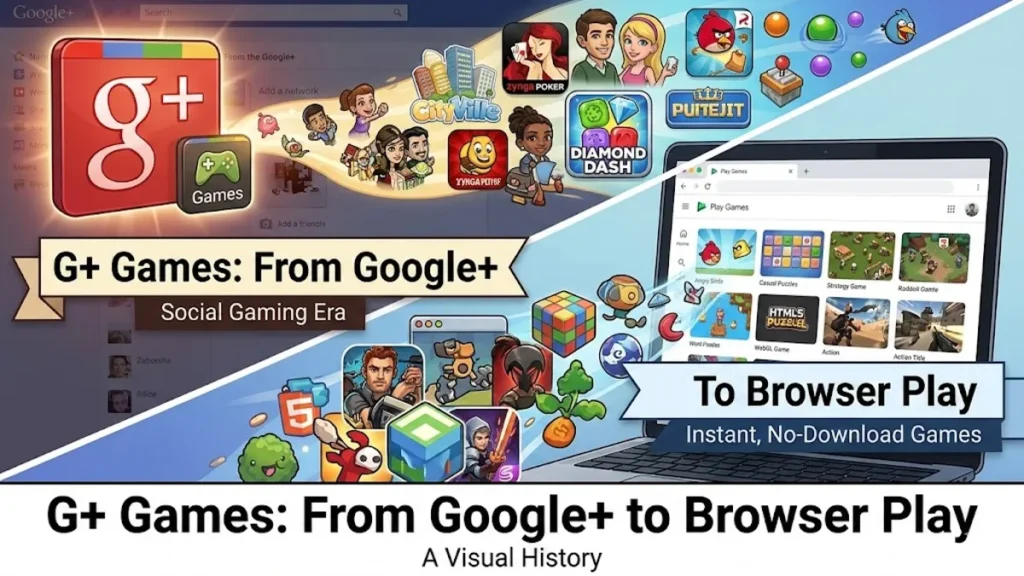

When readers search for “G+ games,” they are usually trying to understand two things: what the term originally meant and why it continues to appear in conversations about browser gaming. In practical terms, G+ games first referred to the suite of casual titles embedded within Google+, the social network launched in 2011. Today, the phrase more commonly describes unblocked browser-based game’s that can be played instantly without downloads, often on restricted networks such as schools or workplaces.
I remember the early excitement surrounding Google+. It was positioned as a serious rival to Facebook, complete with “Circles,” curated social sharing and a built-in games hub. The games were simple and social, designed to keep users engaged inside the network. That experiment did not last long. By 2013, Google discontinued the gaming feature, and Google+ itself eventually shut down for consumers in 2019.
Yet the phrase “G+ games” persisted. It drifted away from its original corporate meaning and took on new life in online communities. Today, it signals quick-access, browser-playable entertainment that prioritizes speed and accessibility. Understanding G+ games requires examining both chapters of that story: the brief era of Google+ social gaming and the rise of lightweight web games that now carry the label.
The Origins Inside Google+
Google+ launched on June 28, 2011, as Google’s ambitious entry into social networking. Alongside features such as Circles and Hangouts, the company introduced a dedicated Game’s tab. The goal was clear. Social play had already proven successful on Facebook, where titles like FarmVille attracted millions of users. Google sought to replicate that momentum within its own ecosystem.
The games available on Google+ were largely casual. They included puzzle, strategy and simulation titles designed for short sessions. Players could compete with friends, compare scores and send invitations within their circles. The design emphasized light engagement rather than deep immersion. These were not console-level experiences but browser-based diversions that fit neatly into social browsing habits.
Despite the effort, adoption lagged. Competition from Facebook’s established gaming infrastructure and the rapid growth of mobile app stores shifted user attention. By mid-2013, Google shut down the Games feature as part of a broader restructuring of Google+. The experiment ended quietly, marking one of several attempts by major tech firms to integrate gaming directly into social networks.
Read: PKHeX Guide: Editing Pokémon Save Files Safely
From Social Feature to Search Term
After Google+ games disappeared, the phrase “G+ game’s” did not vanish. Instead, it evolved. Online communities began using the term more loosely, often to describe unblocked browser games that could be accessed on networks where traditional gaming sites were restricted.
This shift reflects a common pattern in digital culture. Language adapts faster than corporate branding. Once a phrase enters user vocabulary, it can detach from its original source and acquire new meaning. In this case, “G+ games” became shorthand for quick, accessible web-based entertainment.
These modern G+ games typically run on HTML5 or similar web standards. They require no downloads and often no login credentials. Players open a browser tab, click a title and begin playing instantly. The simplicity echoes the early Google+ gaming model, even though the connection is mostly linguistic rather than technical.
Why Browser-Based Games Endure
Browser-based game’s occupy a unique niche in the gaming ecosystem. They offer immediacy. There are no installation processes, no storage concerns and no lengthy updates. For students using Chromebooks or workers on restricted devices, that accessibility is essential.
Casual gaming researchers have long observed that short play sessions can serve as cognitive breaks. These games are not designed to replace full-scale console or PC experiences. Instead, they provide quick entertainment during downtime. Their low barrier to entry broadens participation across age groups and technical skill levels.
Another factor is device compatibility. Browser game’s function across operating systems, from Windows laptops to tablets and even smartphones. That flexibility reinforces their relevance in a fragmented digital environment where users switch devices frequently.
The modern interpretation of G+ games aligns perfectly with this accessibility-first model. They are simple, immediate and easy to close when responsibilities call.
Comparing Two Eras of G+ Games
| Feature | Google+ Social Games (2011–2013) | Modern “G+” Browser Games |
|---|---|---|
| Platform | Embedded in Google+ | Independent web hubs |
| Social Integration | High | Minimal |
| Installation Required | No | No |
| Access on Restricted Networks | Limited | Often possible |
| Longevity | Short-lived | Ongoing |
| Dimension | Social Network Gaming Era | Browser Gaming Era |
|---|---|---|
| Primary Device | Desktop browsers | Chromebooks, laptops, phones |
| Monetization Model | Platform-driven | Varies by site |
| User Motivation | Social competition | Instant entertainment |
| Cultural Impact | Tied to network growth | Tied to accessibility |
These comparisons reveal how the phrase has traveled across technological shifts. The structure changed, but the appeal of low-commitment gaming remained constant.
Cultural Shifts in Casual Play
The early 2010s were defined by social network integration. Platforms attempted to keep users inside their ecosystems by offering game’s, messaging and media sharing all in one place. As smartphones gained dominance, attention migrated to mobile app stores, where richer games could be installed and monetized through in-app purchases.
In that transition, lightweight browser games might have faded. Instead, they adapted. Schools and workplaces often blocked gaming platforms, but browser-based titles slipped through filters. The result was a parallel gaming culture built around accessibility.
The endurance of the “G+ games” label reflects nostalgia as much as practicality. For some, it recalls a moment when gaming felt simpler and less commercial. For others, it is simply a search term that leads to playable content.
Expert Perspectives on Accessibility
Digital media researcher Dr. Maya Lopez argues that accessibility remains the defining feature of browser gaming. “Low technical barriers widen participation and sustain interest in casual play,” she says.
Gaming analyst Jordan Fields notes that “the continued search traffic around terms like G+ games shows how users prioritize convenience over brand identity.”
Game designer Avery Clarke emphasizes design simplicity. “Approachable mechanics and quick feedback loops are central to why browser games continue to attract players,” Clarke says.
These insights suggest that the longevity of the term stems not from corporate branding but from user behavior. When play is easy, language sticks.
The Economics of Simplicity
Unlike major console or mobile ecosystems, browser-based gaming hubs often operate with minimal overhead. Many rely on advertising rather than subscriptions. Their infrastructure costs are lower than those of large-scale multiplayer platforms.
However, sustainability remains a question. Hosting games, maintaining servers and ensuring security require resources. Smaller web-based platforms must balance revenue with user expectations of free access.
The absence of heavy monetization can be appealing. It reduces friction and allows players to focus on gameplay. Yet long-term viability depends on steady traffic and manageable operating expenses.
The story of G+ games, therefore, intersects with broader conversations about digital sustainability and platform economics.
Takeaways
- G+ games originally referred to casual titles inside Google+, launched in 2011.
- Google discontinued its Games feature in 2013, and Google+ later shut down for consumers.
- The phrase evolved to describe unblocked, browser-based games requiring no downloads.
- Accessibility and immediacy are central to their appeal.
- Browser games thrive on low barriers and cross-device compatibility.
- The term’s persistence reflects user-driven language rather than corporate branding.
Conclusion
The journey of G+ games illustrates how digital culture reshapes meaning. What began as a feature inside a short-lived social network has become shorthand for instant browser entertainment. The corporate product disappeared, but the idea of accessible, low-friction play endured.
I see this evolution as emblematic of the broader internet. Platforms rise and fall, but user habits persist. People continue to seek quick diversions that fit into busy schedules and restricted environments. They gravitate toward tools that require little setup and offer immediate rewards.
In that sense, G+ games are less about Google and more about accessibility. They represent a recurring demand for simple play in a complex digital landscape. As technology continues to shift, the language may change again. The underlying desire for easy, universal access to games likely will not.
FAQs
What were G+ games originally?
They were casual browser-based games integrated into Google+ between 2011 and 2013.
Are G+ games still officially connected to Google?
No. Google discontinued Google+ games in 2013, and the consumer version of Google+ closed in 2019.
What does the term mean today?
It typically refers to unblocked browser games playable without downloads or installations.
Why are browser games popular in schools?
They often run on restricted networks and do not require software installation.
Do modern G+ games require accounts?
Most browser-based versions do not require registration, allowing quick and anonymous play.