
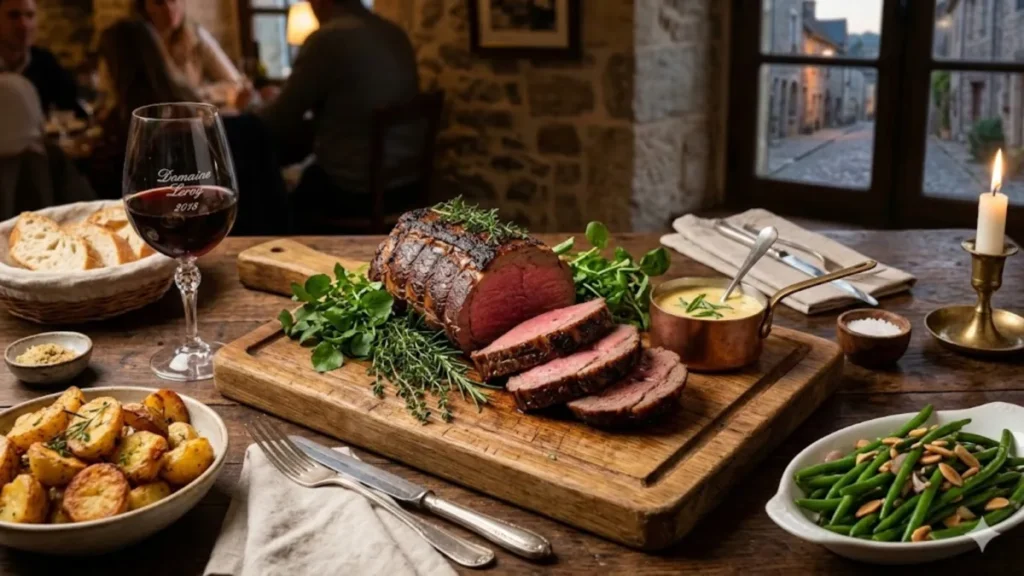

When I think about the most romantic steak ever conceived, chateaubriand rises immediately to mind. At its simplest, it is a thick, center-cut portion of beef tenderloin roasted or grilled and sliced for two. Historically, it referred to a specific French preparation in which a substantial tenderloin roast was grilled between two lesser pieces of meat, which protected it from scorching heat and were later discarded. Today, the term more commonly describes a generous, two-to-three-inch-thick cut from the middle of the tenderloin, prized for extreme tenderness and a mild, almost buttery flavor.
Search for chateaubriand and you will find two things: reverence and confusion. Is it a recipe or a cut? A steak or a roast? The answer is both. It is rooted in early 19th-century France, widely associated with the writer and statesman François-René de Chateaubriand, yet it has evolved into a culinary shorthand for luxury beef cookery. In restaurants from Paris to New York, it arrives sliced into medallions, glossed with béarnaise or red wine reduction, flanked by golden potatoes and a glass of Bordeaux. At home, it is an exercise in restraint: salt, heat, time, and patience.
What emerges from that discipline is a dish that honors beef at its most tender, and French cuisine at its most elegant.
Read: Madalad: From Estonian Word to Blockchain Security
A Name Born of Politics and Appetite
The story most frequently told begins with François-René de Chateaubriand, the aristocrat, diplomat, and author of Mémoires d’outre-tombe. According to culinary lore, his personal chef, Montmireil, created a new preparation of beef for him in the early 1800s. The Larousse Gastronomique, long considered a foundational encyclopedia of French cuisine, records that the dish was named in his honor (Montagné, 1961).
Food historian Alan Davidson also notes in The Oxford Companion to Food that the name likely refers originally to a method rather than merely a cut, involving a thick fillet grilled between two thinner pieces of meat that were discarded (Davidson, 2014). The outer cuts acted as insulation, protecting the prized center from overcooking over open flames.
The timeline aligns with a France reshaping itself after revolution and empire. Chateaubriand the statesman was an emblem of aristocratic refinement. Naming a dish after him signaled prestige. Whether Montmireil truly invented it or Parisian restaurateurs later adopted the name, the association stuck.
By the mid 19th century, chateaubriand appeared on Parisian menus as a luxurious preparation of tenderloin. Over time, the protective outer meat was abandoned. The name migrated from technique to cut.
From Technique to Cut: What Chateaubriand Means Today
In contemporary kitchens, chateaubriand refers primarily to a center-cut portion of beef tenderloin, typically weighing between 500 grams and 1.2 kilograms. It is significantly thicker than a standard filet mignon and designed to serve two people generously.
The beef tenderloin itself runs along the spine of the cow and does little work, which explains its tenderness. According to the United States Department of Agriculture, tenderloin is among the leanest cuts of beef, with approximately 135 calories and 6 grams of fat per three-ounce cooked serving (USDA FoodData Central, 2019).
What distinguishes chateaubriand from other tenderloin steaks is its thickness and central location. The tapered ends are trimmed away, leaving the most uniform, cylindrical portion. That even shape ensures consistent doneness.
Chateaubriand vs. Filet Mignon
| Aspect | Chateaubriand | Filet Mignon |
|---|---|---|
| Cut Location | Center of tenderloin | Tapered end of tenderloin |
| Typical Weight | 1–3 lbs total | 4–8 oz per steak |
| Thickness | 2–3 inches | 1–2 inches |
| Servings | Two or more | Individual |
| Cooking Method | Sear and roast, then slice | Quick grill or pan-sear |
| Presentation | Sliced medallions | Whole steak |
The key distinction lies in scale and service. Filet mignon is intimate and individual. Chateaubriand is communal, sliced and shared.
The Ritual of Cooking at Home
Preparing chateaubriand at home demands precision rather than complexity. I approach it as a sequence of deliberate steps that honor the integrity of the meat.
First, the tenderloin must be trimmed and, if slightly tapered, tied with kitchen twine to maintain a uniform thickness. It rests at room temperature for 30 to 60 minutes, seasoned generously with kosher salt and cracked black pepper.
A heavy, oven-safe skillet is heated until nearly smoking. A neutral oil or clarified butter goes in, followed by the meat. Each side is seared for two to three minutes, forming a dark crust through the Maillard reaction.
Then the pan moves into a 175 to 190 degrees Celsius oven. Internal temperature is the true guide. For rare to medium-rare, the center should reach 52 to 54 degrees Celsius. Resting under loose foil for at least 10 minutes allows carryover cooking and juice redistribution.
As chef Thomas Keller once observed, “The quality of the ingredients is paramount, but so is the respect you show them” (Keller, 1999). With chateaubriand, restraint defines success.
Sauce as Counterpoint
Chateaubriand’s flavor is famously mild. Its tenderness verges on delicate. Sauces therefore provide necessary contrast, structure, and aromatic lift.
Auguste Escoffier, in Le Guide Culinaire, describes classic béarnaise as an ideal accompaniment to grilled tenderloin, built from egg yolks, clarified butter, tarragon, and vinegar reduction (Escoffier, 1903/1979). The sauce’s acidity and herbal depth balance the meat’s richness.
Modern adaptations range widely:
| Sauce | Core Ingredients | Effect on Dish |
|---|---|---|
| Béarnaise | Tarragon, egg yolk, butter, vinegar | Creamy, herbal lift |
| Peppercorn | Black pepper, cognac, cream | Warm spice, richness |
| Red Wine Reduction | Shallots, wine, stock | Deep savory gloss |
| Chimichurri | Parsley, garlic, vinegar | Bright acidity, freshness |
| Salsa Verde | Herbs, capers, olive oil | Piquant contrast |
Julia Child famously wrote, “The beef is the star, but the sauce is the applause” (Child, 1961). In a chateaubriand service, the sauce must complement rather than dominate.
Potatoes and Pairings
Traditionally, chateaubriand appears with château potatoes, small barrel-shaped potatoes sautéed in butter until crisp outside and tender within. Their golden crust echoes the seared beef.
Wine pairing follows classical French logic. Right Bank Bordeaux, dominated by Merlot, offers moderate tannins and supple fruit that align well with tenderloin’s subtlety. Malbec from Cahors or Argentina provides a slightly bolder fruit profile without overwhelming the dish.
Karen MacNeil, author of The Wine Bible, notes that lean, tender cuts benefit from wines that provide structure without aggressive tannin (MacNeil, 2015). Because tenderloin contains less fat than ribeye or strip steak, overly tannic wines can seem harsh.
The pairing becomes an orchestration of balance. The meat delivers texture. The sauce adds nuance. The wine completes the arc.
Nutritional Perspective and Modern Context
Despite its indulgent reputation, chateaubriand is relatively lean compared with other premium cuts. A three-ounce portion of cooked tenderloin provides high-quality protein with comparatively modest fat content, according to USDA data (USDA FoodData Central, 2019).
That nutritional profile partly explains its enduring appeal. Diners seeking refinement without excessive richness often gravitate toward tenderloin.
Still, beef production carries environmental implications. The Food and Agriculture Organization of the United Nations reports that livestock accounts for roughly 14.5 percent of global greenhouse gas emissions (FAO, 2013). Responsible sourcing, from grass-fed operations to regenerative farms, increasingly shapes purchasing decisions among chefs and home cooks.
In contemporary fine dining, chateaubriand symbolizes continuity. It stands at the intersection of heritage and adaptation, luxury and simplicity. It can be prepared in a rustic farmhouse kitchen or presented on porcelain beneath crystal chandeliers.
Chateaubriand in Restaurant Culture
In Paris during the 19th century, large-format meat dishes signaled generosity and refinement. By the early 20th century, chateaubriand appeared on grand hotel menus across Europe.
In the United States, steakhouse culture adopted the dish as a theatrical centerpiece. Carved tableside, it evoked ceremony. The ritual slicing underscored the communal aspect of dining.
Chef Jacques Pépin once remarked that classic French dishes endure because they are “logical combinations of flavor and technique” (Pépin, 2012). Chateaubriand embodies that logic. The tenderloin’s uniformity makes it ideal for precise roasting. Slicing reveals an interior blush that contrasts with its seared crust.
Even as culinary trends shift toward nose-to-tail butchery and lesser-known cuts, chateaubriand retains its place as an emblem of classicism. It does not rely on novelty. It relies on execution.
Technique Deep Dive: Temperature and Timing
Precision matters profoundly with chateaubriand. Because the cut is lean, overcooking can produce dryness.
Professional kitchens rely on thermometers. Rare falls around 50 to 52 degrees Celsius. Medium-rare, widely considered optimal, sits between 52 and 54 degrees. Resting can raise internal temperature by several degrees through carryover cooking.
Searing creates crust. Roasting finishes gently. Some chefs reverse the order, beginning in a low oven and finishing with high-heat sear for maximal control.
The goal remains constant: a rosy center from edge to edge.
Takeaways
- Chateaubriand originated as a French technique linked to François-René de Chateaubriand in the early 19th century.
- Today it refers primarily to a thick center-cut beef tenderloin roast for two.
- Its defining qualities are extreme tenderness, mild flavor, and uniform thickness.
- Classic accompaniments include béarnaise sauce, red wine reduction, and château potatoes.
- Precision in searing, roasting, and resting ensures optimal medium-rare results.
- Compared with other steaks, tenderloin is leaner and less intensely beefy.
- Its enduring appeal lies in elegance, simplicity, and shared presentation.
Conclusion
Chateaubriand persists not because it is extravagant, but because it is disciplined. It demands high-quality beef, careful seasoning, attentive heat, and patience. It rewards the cook with slices that glisten, tender enough to yield beneath the gentlest pressure of a knife.
Across centuries, the dish has shed some of its original ritual. Few modern cooks grill it between sacrificial cuts of meat. Yet the spirit of protection remains. We guard it from overcooking. We rest it before slicing. We treat it with the quiet seriousness reserved for something precious.
In a culinary landscape often driven by reinvention, chateaubriand stands as a reminder that mastery sometimes lies in refinement rather than reinvention. A single cut of beef, prepared with intention, can carry history, culture, and shared pleasure to the table.
FAQs
What cut of beef is chateaubriand?
It is a thick center-cut portion of beef tenderloin, trimmed for uniform shape and typically serving two people.
Is chateaubriand the same as filet mignon?
No. Filet mignon is a smaller steak from the tapered end of the tenderloin, while chateaubriand is a larger center section meant for sharing.
What temperature should chateaubriand be cooked to?
Medium-rare, around 52 to 54 degrees Celsius internally, is widely considered ideal for tenderness and juiciness.
Which sauce is traditional with chateaubriand?
Classic accompaniments include béarnaise sauce and red wine reductions with shallots and herbs.
Is chateaubriand lean?
Yes. Tenderloin is among the leaner premium cuts of beef, with relatively low fat compared to ribeye or strip steak.